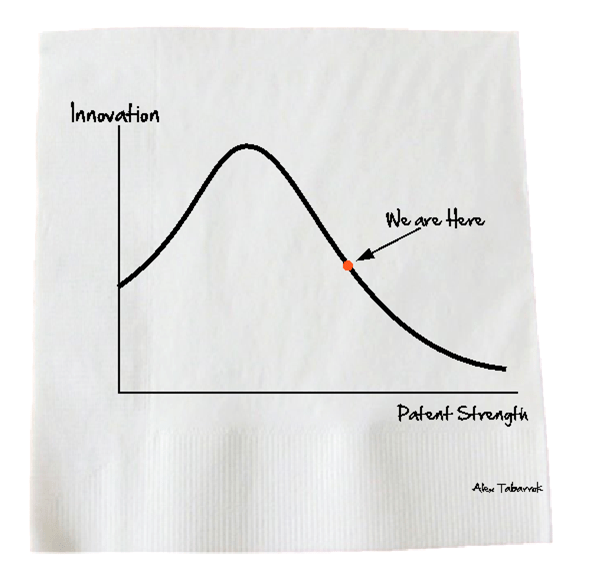
Thursday, June 19, 2014

A Court Drawn to Horse, Buggy and Total Technical Incompetence

It seems inevitable that our collective elevator ride back down to those future-shocking New Medieval Ages
should include a stop over at that retail sell-out floor called
Patently Incompetent SCOTUS Justices On Sale Here (the PIS-JOSH floor).

Today's Supreme Court (SCOTUS) decision in Alice Corporation Pty. Ltd. v. CLS Bank International (2014) does not surprise. After all, we saw in the oral arguments how naive the Justices were with respect to giving a coffee clutchful of Silicon Valley "coders" an "idea" and telling them to "make it so" over the weekend on a "general purpose computer". (a.k.a. the "generic" computer") ... The Alice-in-Blunderland Supremes summarized their holding in the following:

"Viewed as a whole, these method claims simply recite the concept of intermediated settlement as performed by a generic computer. They do not, for example, purport to improve the functioning of the computer itself or effect an improvement in any other technology or technical field. An instruction to apply the abstract idea of intermediated settlement using some unspecified, generic computer is not “enough” to transform the abstract idea into a patent-eligible invention. Id., at ___. Pp. 14–16."

As Forrest Gump was known to quip, 'simple is as simple thinks' or something generically like that.

Patent law pundits are all over the map on this one:
Don't Ask Alice, What did our Supreme Humpty Dumpties mean?

Some say "software" patents have been severely set back

Others say "software" is not at all affected because the Supremes didn't say the S-word

Yet others (the EFF) celebrate the end of all "software" patents.


Wednesday, June 4, 2014

Unreasonable Uncertainty from Questionably Serious SCOTUS Men (and gals)

The uncertainty principle is a prime theme in the Cohen Brothers film, A Serious Man.

The Questionably Serious Men
and Women of SCOTUS
have fed fresh fuel into the fires
of irrational certitude with their theory
of "reasonable certainty" in NAUTILUS, INC. v BIOSIG:

In place of the “insolubly ambiguous” standard, we hold that a patent is invalid for indefiniteness if its claims [all of them, any of them?] , read in light of the specification delineating the patent [delineating? huh? WTF does that mean?] , and the prosecution history, fail to inform, with reasonable certainty, those skilled in the art about the scope of the invention.

...posting still under construction

Thursday, April 17, 2014

No you don't C# Justice Breyer

"Seeing" requires more than
just considering your eyes
and saying "apply them".

"Seeing" means taking note
of ALL the details by using
an appendage of the eyeballs
sometimes referred to as the brain.

In the released tape recordings of Alice v. CLS

(here)
Justice Breyer claims to see the whole picture
as being nothing more than:
(1) King Tut's pile of gold and chits
(2) An abacus-using man
(3) And the abstract idea of Mom yelling "Stop!" (if you C# where he is going with that).

That indeed is comical
but at the same time dishonest
and disrespectful of the full list
of patents and claims involved
and of the specific details of
their complex and detailed disclosures.

TO ABSTRACT ALL THIS COMPLEXITY DOWN
TO THE SIMPLITUDE OF
HAVING AN "IDEA" AND
SAYING APPLY IT TO "A COMPUTER"
and then CALLING YOUR OWN ABSTRACTION,
AN "ABSTRACTION"
is no different than
killing your parents and labeling yourself
an un-entangled "orphan" deserving of mercy.

Seriously?
Are these Serious Men (and Women)?
Is ignorance of your own ignorance an excuse under the law?

At times in the audio tape (link also above)
we can hear the Justices nervously laughing
at the admittedly complex geek flowcharts
with their boxes and arrows going all over the place.

Transcript page 30:
24 CHIEF JUSTICE ROBERTS: Well, that's a
25 little more complicated. He referred us to Joint
[Transcript page 31:]
1 Appendix Page 159, which is not a change in how
2 computers work. But it is constitutes the
3 instructions about how to use the computer and where it
4 needs to be affected. And just looking at it, it looks
5 pretty complicated. There are a lot of arrows and
6 they you know, different things that go 7
(Laughter.)
8 CHIEF JUSTICE ROBERTS: Well, but I mean,
9 you know, it in different directions. And I
10 understand him to say that in each of those places,
11 that's where the computer is needed.

[post incomplete and still under construction]


Tuesday, April 1, 2014

Close Patent Encounters of the Go Ask Alice Kind


Well, thanks to the oral hearings transcript (here)
and tape recorded orals (here)
for March 31, 2014
we finally have first contact
(of the King Tut kind) with
the mythologies, thoughts and fantasies that are bubbling and troubling within the heads of our Supreme Court Justices.

The crux of the issue,
in Alice v. CLS [Big] Bank
apparently revolves around "ideas" and not just ideas, but those of the subclass, "abstract" (as opposed to those of the subclass, "concrete") and the triviality of "coding" it once the idea is stated.

According to Justice Ginsburg there is a
"degree" of abstractness in
each of the " abstract ideas".
Some ideas are apparently more abstract than others.
Page 4 of oral hearing transcript:

5 JUSTICE GINSBURG: Mr. Phillips, on the
6 abstract idea [thing], you know that the Bilski case held that
7 [computer-implemented] hedging qualified as an "abstract idea."
So how is ... 8 [computer-implemented financial and] intermediate
settlement [any less of an] abstract [idea] than [Bilski's] hedging?

According to Justice Kennedy, irrespective
of whether an "idea" is abstract or concrete,
once you have it, and state that idea to any handful of computer geeks, implementation is trivial:
Page 5, line 7:
7 JUSTICE KENNEDY: Well, let me put it this
8 way. If you describe that [(where "that" may refer to the whole of Alice's patent disclosure as summarized by PHILLIPS at pg 4, ln 16-pg 5, ln 6)] to a second year college
9 class in engineering and said "here’s my idea,"
10 now you go home and
you program ["that" on a single "computer"] over this weekend, my
11 guess is my guess is that that would be fairly easy
12 to program [because "programming" is all that is needed].

Page 12: (more on triviality of coding)
8 JUSTICE KENNEDY: Suppose I thought and,
9 again, it’s just a thought because I don’t have the
10 expertise that any computer [-savvy] group of people sitting
11 around a coffee shop in Silicon Valley could do this
12 over a weekend. Suppose I thought that.
13 MR. PHILLIPS: You mean wrote the code?
14 JUSTICE KENNEDY: Yes, right. [All that is needed is to write "code".]
...
Page 5: (continued from above)
15 JUSTICE KENNEDY: So the fact that the [one --(not true), see US5970479 at right]
16 "computer" is involved, it it seems to me, is necessary
17 to make it [(the whole system)] work.
But ... the innovative aspect
18 is certainly not in the creation of the program to make
19 that work [because programming is what any coffee clutch worth ..
of Silicon Valley nerds can do]. All you're talking about
[after stripping everything away, despite what 35 USC 112 says about inventor's regard]
is if I can use ... 20 the word [is merely] an "idea."
[In other words, in so far as what I, Kennedy J. understand, you are claiming no more than "an idea"!]

[... post still under construction ...]
SOME CASE ASPECTS ARE LEFT OUT OF THE ORAL HEARINGS THOUGH ...
(Click Read More to read on)

Friday, March 21, 2014

The Fifty Shades of Elephant Gray that is "Software"


Like the finches of Darwin's Galapagos Islands,
the term "software" has evolved over the years
to represent subtly different things to different people.
Our language does not have 50 different shades
of word for the different species we collectively call "software".

It's as if we used the term "flying things" for Darwin's finches and we didn't comprehend that such imprecise terminology just doesn't quite cut it for serving the needs of a "modern" science-based society.
And thus, when it comes to the "software" stuff, we are often caught pushing each other
off the proverbial Tower of Babel as we debate what is and isn't "software"
and whether "it" should be patent eligible.


[still under construction] ....
One writer **here** (a Mr. Martin Goetz) claims that he has the definitive definition of what software is is.
That can be disputed.

Take for example, the “configuration bits” that are loaded into a Field Programmable Gate Array (FPGA). These ones (1's) and zeroes (0's) are not instructions for execution by a “computer” but rather they are controls for how the reconfigurable signal routing wires of the FPGA are to be routed and how the reconfigurable logic blocks of the FPGA are to be configured. It is indeed “software”, but not a kind that is “executed” by a computer. So anyone who claims that all “software” is computer executed software is overstepping the bounds of reasonableness.
By the same token, anyone who claims that all “software” is pure “math” is equally stepping outside the bounds of reasonableness. (Click 'Read More' below to read more.)

Sunday, March 9, 2014

Let's Hate the Inventors

We have to hate somebody.

Maybe we should hate blacks?
No. Can't.
Not politically correct.
Don't dare use the N-WORD.


Maybe we should hate gays?
No. Can't.
No longer politically correct.
Don't dare use the F-WORD,
or any other LGBT derogatory word.


Maybe we can hate inventors?
Yes. Finally. Totally politically correct.
Do use the T-WORD.


Inventors aren't even real people.
Why they're "nerds". Ugly hideous things who hide under the bridge.
Honestly when was the last time you ran into a "true" inventor, meaning someone who went all the way by building the thing in her garage and then mass producing it and getting everyone to instantly love it and buy it? That's "innovation". Anything less is nothing.

So go ahead. Do use the T-word.
Everyone else does.
Here, here and here.

Why even the US government hates them.
Lookie here at what the US President said about them in his 2014 SOTU speech.

In its brief to the Supreme Court, the government said
inventors use "schemes".
They rely on "shadow records".
They claim "abstract ideas".
They spread their evil doings into "traditionally non-technological fields of human endeavor" and for that reason we must be vigilant and enforce "traditional limits" on them.


Get the picture?
Got it? Get them. Good.


More Hate Pieces:
1) A "Final Solution" for them who dare to invent
2) Obama: the Great T-word Slayer
3) The Patent ‘troll’ label ... worthy of ponder
4) More T-word stories


"I think this [Kill-Inventors-Bill] could get done if we keep our nose to the grindstone."

Sunday, March 2, 2014

Quid Quo Vait Fo' Us (#Hyatt)

Never mind "12 Years a Slave".
How about 40 years an inventor in waiting? (#Hyatt)

How about inventor man without a country?
(Because your Gov't is waging a "War on Inventors"?

When do America's inventors get their applause?
Their moment in the sun?
Or is America's innovative fire doused out by bureaucratic hope-kill and political kah ching?