Wednesday, December 16, 2015

Only the Echos of Their Abstractinating Minds

Midnight cowboys know that the day after, all that remains are the scratches on the vinyl recordings from the oral hearings.

A couple of post phonic analyses of McRO v. Bandai may be found here and here.

Which of the possible reverberations sums it up?

Syncopation?

Synchronization?

Morphed ideations?

Or, was it a silent conspiracy between accused and judge to sweep the details under the rug?

At the end of the day, District Judge Wu found himself not fooled by the details (or by a subconscious desire to summarily dispose of the arduous labor of full trial) and found the claims "directed" to:
the abstract idea of
"lip synchronization
using a rules-based morph target approach
"

How convenient for both judge and the accused defendant who formulated that contraction.

At the close of appellate oral arguments, McRO's lawyer wanted to know what ever happened to the separate ideas of sequence and timing and transition curves? Where was that as a routine in the prior art? Why did all the claim details disappear?

Silence.

Thursday, December 10, 2015

Upcoming 101 Oral Arguments

Question that should have been presented: Are claims of patent "directed" to intrinsic patent disclosure of which they are an integral part or are they "directed" to an arbitrary extrinsic concept made up by a "trust my subjective judgment" judge, examiner or; more often, accused infringer?

From http://www.cafc.uscourts.gov/argument/upcoming-oral-arguments :

Panel O: Friday, December 11, 2015, 10:00 A.M., Courtroom 203
15-1080 DCT McRo, Inc. v. Bandai Namco Games America

Should be an interesting one

Link to District Court 101 PDF holding here

PatentDocs review of DC 101 ruling here.

News brief here

p.s. of 12/11/2015: Oral hearings recording here.

UPDATE: Patent Arcade's Summary of Oral Hearings is here.

Another report on the Oral Hearings is here: "Software Patent May Survive Scrutiny"

Link to text of McRO's US Pat. 6,611,278 here.
Link to Google copy of 6,611,278 here

From the 6,611,278 patent (col 4, line 32): "The method preferably comprises a set of rules that determine what the output morph weight set stream will be when any sequence or phonemes and their associated times is encountered. As used herein, a "morph weight set" is a set of values, one for each delta set, that, when applied as described, transform the neutral mode to some desired state, such as speaking the "oo" sound or the "th" sound. Preferably, one model id designated as the anchor model, which the deltas are computed in reference to. "


Friday, December 4, 2015

Judge L. Lets Loose his Laws re Laws of Nature and Abstarctitude

Like Prometheus bound to his rock and pecked at by dark demons, Judge L. of the Court of Appeals feels himself sentenced to an equal fate by the 9 Demigods of our Mount Olympus. He quails:

"I find no principled basis to distinguish this case from Mayo [v. Prometheus], by which we are bound. I write separately to express some thoughts concerning laws of nature and abstract ideas" --ARIOSA DIAGNOSTICS, INC. v. SEQUENOM, INC. (Fed. Cir Dec. 2, 2015 -another of infamy's dates) [For more discussion, check out IPWatchDog here.]

Based on rock solid rationale, he proclaims:

"Laws of nature are exact statements of physical relationships, deduced from scientific observations of natural phenomena. They are often represented by equations, and include such laws as the relationship between energy and mass (E=mc2), the relationship between current and resistance (Ohm's Law), that between force, mass, and acceleration (F=ma), Maxwell's equations, Newton's laws of motion, and many more."

He enlightens we the blind ones with this flash of genius:

"Abstract steps are, axiomatically, the opposite of tangible steps; that which is not tangible is abstract. But steps that involve machines, which are tangible, steps that involve transformation of tangible subject matter, or tangible implementations of ideas or abstractions should not be considered to be abstract ideas."

What's wrong with Judge L.'s ideas?

Let's start with one of his simpler "laws". Ohm's Law.
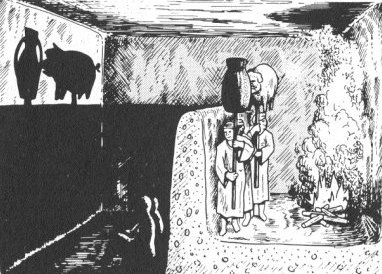
This so-called “Law” (and don't forget Moore's) cannot logically be part of the kit when Mother Nature finally comes down from the mountain top with holographic clay tablets clutched to bosom to declare her Universal absolutes. Rather it is merely one of our current delusions and illusions as seen through human eyes. Mass? Energy? E=mc^2? Is that “truly” how the Universe is put together or just our current projection onto Plato’s allegorical cave wall?
Clearly V=I*R (Ohm’s “law”) is a delusion because in the real world there is no homogeneous R device that has linear conversion of “current” to “voltage” over all ranges and all temperatures. It is merely a model, an idealistic or abstract model. Not a “law” that Mother would approve of.


Judge L.'s wrong headed notions about Laws "of Nature" (meaning proclaimed by Mother herself) are just a tip of the iceberg example of judges gone wild and bouncing off the walls of Plato's Cave.

First and foremost are the Royal Nine feeding us LSD-laced Mayo-naise about how response to dosage by humans with unique DNA combinations is totally predictable based on their own invented Law "of Nature" (their unspecified "correlations").

Wednesday, November 25, 2015

Anti-Patent Coders can never be wrong because they have purely logical biological brains

Let's face it.
To be human is to be fallible to the illogical.

To be human is to be susceptible to emotion rather than reason.

In this post we examine one particular article:
How to Misunderstand Free Software
which includes illogical, ill-informed anti-patent sentiments.

At one point the article proclaims:
"Copyright is very important ... Patents in software, on the other hand, are a very controversial concept. To put it shortly: there is no such thing as a "patented software". By registering for a patent, however, someone can claim ownership over a process. The patent then applies to all software that use this process, whether proprietary or free.

[Note: The author does not understand copyright law. A copyright protects a specific "expression" as affixed in a tangible medium. It does not protect inventions.]

[Note: The author does not understand patent law. One does not "register" a patent and one does not claim software per se becuse there is no clear definition of what software is. One "applies" for a patent for a new and useful machine, process, manufacture or composition of matter.]

At another point the article asserts:
"... software is just code, code is only math. Once you view software as useful math, an elaborate language, not like ordinary property, there is no reason to restrict others' use of it. Just like math (where nobody would claim property on an equation), software requires advanced knowledge to be adapted, improved, applied correctly."

[Note: The author does not understand physics. Software and code are not one and the same. Code is anything that at some point gets decoded or re-coded, for example Morse code is re-coded into alphabet letters. Software can come in many forms, not just source code. For example your passwords can be thought of as software. And yes Virginai, there are reasons to restrict.]

"Free software is not about killing incentives for programmers. It's about seeing code as knowledge which should not be hidden from the user."

[Note: The whole point of object oriented programming is to encapsulate and thus hide knowledge from users. Too much knowledge can be a dangerous thing.]

"Imagine purchasing a car whose hood you are forbidden to open. It does not matter whether you know how a car works – the point is that nobody will be able to check the engine. How can you trust your car, if no one is allowed to make sure that it's reliable, that it does not leak, that it's not harmful to the society and environment?"
"The idea is the same with software – except that code does much more than move cars. Software runs our computers, phones, TVs, media players and more, carrying information and our culture."

From another source:
"He who receives an idea from me, receives instruction himself without lessening mine; as he who lights his taper at mine, receives light without darkening me."

D'oh! Please share with your local town burglars the info of when you and family will be out of town for a prolonged vacation. Thank you Mr. Spock-like Know It all.

Friday, October 30, 2015

Alice Omelette Poured Generously Over Graham Eggshells

At the time that Graham v. Deere (1966) was decided, section 103(a) read as follows:

35 U.S.C. 103 Conditions for patentability; non-obvious subject matter. "(a) A patent may not be obtained though the invention is not identically disclosed or described as set forth in section 102 of this title, if the differences between the subject matter sought to be patented and the prior art are such that the subject matter as a whole would have been obvious at the time the invention was made to a person having ordinary skill in the art to which said subject matter pertains. Patentability shall not be negatived by the manner in which the invention was made."

Alright, said the Supremes to themselves.

We don't know much about biology, history or zoology. Don't know deep algebra, just that 1 plus 1 is two. But about the English language we know a thing or three. We know how to parse a sentence.

It says in this section 103(a) something about "having ordinary skill in the art".
Somebody has got to figure out what that ordinary skill is, what its level is, and they need to do so by presenting "evidence".

It says in this section 103(a) something about "differences" and about the subtractant being "the prior art".
Somebody has got to figure out what the prior art is, what is its scope and content, and again they need to do so by presenting factual "evidence".

It says in this section 103(a) something about "the time the invention was made".
Somebody has got to figure out what that time is. Clearly the ordinary guy could not know what comes after. We best be wary of hindsight and allow for secondary considerations.

The Supremes of the Graham v. Deere era walked on eggshells. Careful not to overstep what the text of the statute said.

Now let's compare that against what the Supremes of Alice v. CLS did ...

Wednesday, October 28, 2015

Dismantling America. So we can be "Great". Again. Like we were before we had patents.

Not long ago, it was turnstile news that the world waited with baited breath for the next great thing coming out of America's technology mill.

It wasn't always that way.

Back in the day of our Philandering Fathers, America was a 3rd world back in the hillbilly woods agricultural society.

It was we who waited with baited breath for the next great technological advance to trickle down to us as soon as the "Great" Britain magnanimously decided to so do.

Then our Tinkering Fathers (e.g. Ben Franklin, ...) had a stroke of some kind. Eureka. Aha. If we gave out patents to "our" tinkerers and inventors we wouldn't be waiting around for Great Britain.

Today. We have great thinkers who want to make America "Great" again by going back to the old ways. By doing away with patents. By rolling back the clock to the good ole boy days when we waited with baited breath for them instead of them for us.

Tuesday, October 27, 2015

The Myth and the Magic

"I think it, therefore it is." (... true, that is)

Descartes didn't say that.

However many a modern day magical thinker believes it.

8 JUSTICE KENNEDY: Suppose I thought - and,
9 again, it's just a thought because I don't have the
10 expertise - that any computer group of people sitting
11 around a coffee shop in Silicon Valley could do this
12 over a weekend.

In other words:
The Myth of Basic Science
("The implications of this new way of seeing technology—as an autonomous, evolving entity that continues to progress whoever is in charge—are startling. People are pawns in a process. We ride rather than drive the innovation wave. Technology will find its inventors, rather than vice versa.")
Blogger's Note: So I need not have bothered writing this piece because inevitably someone else would have. And you need not have read this piece because inevitably someone else would have (read the other chap's piece). Pawns are expendable. Sit back, relax and just chew your cud.

Or is the rebuttal the correct point of view?
The “myth” of basic science?
("This is a profound misunderstanding of how basic science is translated into useful products. For instance, it is true that there were steam engines before the laws of thermodynamics were worked out, ... In turn, engineering improvements in the steam engine contributed to the understanding of thermodynamics during the 19th century. ... Basically, Ridley postulates the “myth” of basic science as a means of arguing that current patent policy is too stringent and protects monopoly")


Blogger's Note: So let's unilaterally disarm. Throw away our patent laws. Throw away our inventors and their cunning draftsmen lawyers. Sit back and wait for Them to inevitably invent. Piss in our pants when They arrive on our shores with their new inventions ... and then annihilate "Us" slackers. Good idea. Brilliant. Thank you Little Anthony and Clarence the Clown.

Is "innovation" inevitable?
Do patents "stifle" it?
Is the individual inventor irrelevant?
Another Edison or Bell would have surely come along?
Another Newton, Einstein, Darwin, Galileo was queued up and ready to go?

On whose shores?